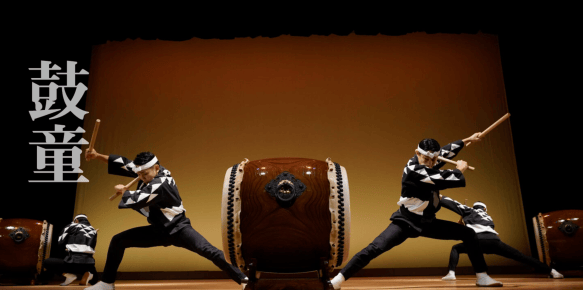
It’s pitch black, with the exception of a few glowing neon yellow lights illuminating the silhouette of five massive drums. And I do mean massive, as big as eight feet across. You can’t tell yet, but there are dozens of instruments, and musicians, hiding on stage. And they’re about to come to life.
It starts as a low rumble, like a stadium full of anxious foot-stomping fans. Then it builds into an all-out roar: a cacophony of thunderous sounds. The reverberation is so heavy I can feel it buzzing in my bones. Waves of bass boom heavy against my chest. The performers lunge, leap, and launch themselves across the stage into the skins of the drums (I’m worried they’ll burst.) It’s equal parts indigenous folk music and sport. I’ve never seen anything like it.
This is Kodo, a performance ensemble keeping the tradition of Japanese folk music, known as Taiko, alive for over 45 years. And yes, their shows are known for their display of pure primal beats presented with jaw-dropping athletic precision. However, it isn’t all raw passion and brute force. There are moments of softness, beauty, and studied grace. It is a celebration of culture influenced by indigenous ceremonies from across the world.
The musicians impeccably time their beats using choreographed movements and the swings of their mallets (which are the size of baseball bats.) Everyone in the packed venue at George Mason’s Center for the Arts can feel their heartbeats syncing in time, thumping together in perfect rhythm.
The name Kodo carries two meanings in Japanese: “heartbeat” and “drum children,” both fitting for an experience that feels both primal and playful. At times it borders on feral, but there’s control in the chaos; every strike perfectly synchronized to fit into place.
I know because I watched the rehearsal.
Not one beat was missed.
Not one mallet was dropped. Ever.
Kodo’s show is more than massive drums. During one performance, a delicate bamboo flute (the fue) pierces through the percussive storm, floating like a fine mist over a mountain. The shamisen, a Japanese three-stringed instrument, hums in tune, balancing out the seismic energy of the drums. And finally, the koto, a six-foot long 13-stringed traditional Japanese zither, weaves light, plucky notes into the tapestry of melodies.
There’s a hypnotic beauty to the unwavering precision of Kodo’s performers. Every detail, from the way they stand to the arc of their swings, is rehearsed until it’s as natural as breathing.
There’s no sheet music. Like most indigenous music, Taiko is an oral tradition, learned completely by ear, and played from memory. The musicians don’t just play their instruments; they become them.
It’s no surprise to find out that their training is as rigorous as an Olympic athlete’s.
To better understand Taiko, I turn to Mark H. Rooney, a DC-based Taiko instructor and longtime student and teacher of the tradition. Rooney has spent 27 years immersed in Taiko, touring all over the U.S., Europe, and Japan. He’s even worked with Kodo during the North American leg of their One Earth tour.
“Kodo’s mission,” he explains, “is to preserve a lot of the cultural aspects of Japan, including folk music.” Taiko is an integral part of Japanese culture, rooted in festival traditions, ceremonies, and theatre, like Kabuki.
He says, “The training… is quite intense. They have an apprenticeship program which goes usually for two years.” During this time, hundreds of students live in a community named the “Kodo Village” on Sado Island in Japan. They learn every instrument used in the show, as well as traditional singing, dance, calligraphy, tea ceremony, and local agriculture.
“Because they live communally, they grow their own food, they prepare their own food,” Rooney says, “It’s a lifestyle.”
Programming Manager Vic Adebusola spoke with me before Kodo’s show about their impact at Mason. “At the Center for the Arts, we like to book acts that are multi-disciplinary, so we’ll have dance, theatre, acting, and art,” he says. “We also like to emphasize cultural music programs, and Kodo is an incredibly famous Taiko drumming organization.”
Kodo’s visit also helps to support music education at Mason, too. They allow students access to watch their rehearsals, and they can even attend a meet-and-greet before the show to ask questions.
During the meet-and-greet beforehand, I spoke with two members of Kodo, both have been with the group for over ten years. Seita Saegusa and Hana Ogawa stepped outside before the show to give us a glimpse inside their lives on tour. Their tour manager, Natsumi Ikenaga, helped translate.
The first question on everyone’s mind: how do they handle the physical demands the show puts on their bodies?
Along with an on-tour masseuse, Ogawa says, “We do a lot of stretching.”
Ikenaga laughs and adds that when touring the West Coast, hotel rooms rarely came with bathtubs. “But here in the east, we find more bathtubs. She enjoys taking a bath.”
After watching their performance, I understand the need for a hot soak post-show.
Saegusa says his favorite part of touring is seeing so much of the world and trying new cuisine.
Ikenaga translates, “This is his first U.S. tour and his first encounter with Mexican food.”
The group erupts in laughter. His eyes light up in agreement.
Ogawa adds, “We’ve explored a lot of hamburgers, also.” It doesn’t get more American than that.
Saegusa reveals that the performers are tasked with the immense work of loading and unloading all the instruments and equipment for each show. The drums, made from a Japanese wood called Keyaki are known for their density and deep reverberation. These drums are so heavy it takes four people to lift one. It’s hard to believe all the drums fit into a single semi truck.
Traditionally, Taiko drums are crafted from one tree, a hollowed-out trunk, making them variably indestructible. The hide stretching across the top comes from cow or water buffalo skins and usually needs replacing every couple of years (yes, they often ‘burst’ open on stage under the pressure.)
Perhaps most impressive is how many of Kodo’s members are small in stature, yet mighty in strength and the powerful sounds they produce. And every musician in the Kodo community leans to play every instrument in the show, regardless of their size, age, gender, or anything else.
When asked how the musicians are able to produce such power show after show, Rooney sums it up quite perfectly, saying, “Power doesn’t come from strength. Power comes from technique.”